 A rare and healthy Bannockburn Yellow Gum in a more protected location than the stressed tree with the mistletoe It was 2002, just five years after the Yellow Gums fiasco I stood under a beautiful old Yellow Gum that appeared to be dying. It was severely drought stressed after 5 years of low rainfall in the middle of the Millennium Drought and it had more than 30 prominant mistletoes sprouting from the canopy. To add to my disappointment, it was just five years since the Yellow Gum’s fiasco in 1997, when Barwon Water cleared 8.5ha of these ancient Yellow Gums, Eucalyptus leucoxylon subsp. connata, from this same location, to construct sewage treatment works for the township of Bannockburn. As a direct result, the tree with the mistletoes was now fully exposed to north winds, at the edge of an open paddock that five years before had featured a magnificant woodland of this rare and important tree. I walked away with the impression that the old tree wouldn’t last another year and that mistletoes were a serious problem. I couldn't have been more wrong! Ten years later, Dr. David Watson conducted his remarkable mistletoe study that showed; ‘Mistletoes are keystone species and an important feature of healthy woodlands and forests.' As a result, Ecologists are now using the ‘One-Third Rule’ - losing native mistletoe from an area will result in the bird population falling by up to one third. David Watsons study is described in my July blog; ‘Mistletoes – magical, mysterious, misunderstood but quintessentially Australian’ It’s a matter of balance I now know that the mistletoe on the distressed Yellow Gum was an indication of nature out of balance, caused by both human and climate induced factors. It's known that the 97 species of mistletoe native to Australia are typically well tolerated by their hosts and provide an important source of food for two thirds of our bird species and 28 species of butterfly. They are a vital part of the web-of-life in our native ecosystems.  This host eucalypt has more than 50% Drooping Mistletoe providing its canopy and is therefore stressed. Photo: Australian National Herbarium Mistletoes - a biological yardstick of ecological health ‘Tracking mistletoe health effectively measures the health of the entire food web’ Ecologists and conservationists can use mistletoes presence or absence to appraise the health of native habitats. Increasing infestations are a useful indicator of unhealthy or unnatural environmental conditions needing some corrective action. It's absence also tells a story of poor management. If the mistletoe population is exploding and occupying more than half of a host tree's canopy. This usually points to broader ecological stresses, such as severe land clearing or over-grazing, though more specifically, the following factors will contibute to mistletoe flare-ups;
Excessive mistletoe growth is therefore more common on roadside trees, isolated paddock trees and planted street trees, because the usual checks and balances provided by a diverse woodland or forest ecology are missing. If the mistletoe population is completely absent it may indicate an ecosystem with a history of extreme natural fire events or being burned too often or too hot to reduce bushfire risk. Mistletoe is highly sensitive to intense heat, and after bushfires or hot fuel reduction burns it's often the first plant to vanish. Even extreme summer heat will kill mistletoes. In the summer of 2009, a prolonged heatwave in Melbourne, that included the hottest day ever recorded (46.4°C), led to the death of 210 out of 237 mistletoes (Amyema miquelii and Amyema pendula) growing on 46 River Red Gums, Eucalyptus camaldulensis. The River Red Gums were affected by the heat but recovered well. Similar effects on mistletoes caused by this extreme heat were reported in eucalypt woodlands and forests across south-eastern Australia. Mistletoes in balance can suggest a history of favourable weather conditions and good management, where the host trees are enjoying ideal soil moisture and nutrients. An approximate measure of mistletoes in balance would be less than 20% of a healthy tree’s leafy canopy. Therefore, looking into the tree's canopy, less than one-fifth of the leaves you see will be mistletoe and over 80% will be healthy host tree leaves.  The remarkable recovery of the shrub-layer in a Box-Ironbark woodland near Benalla as part of the Regent Honeyeater Project Restoring checks and balances when mistletoe is out of control - the Regent Honeyeater project Mistletoe was a serious problem in the isolated remanant patches of box and ironbark woodlands of the Lurg Valley, near Benalla, Victoria. The mistletoe was completely dominating and eventually killing its mature host trees. Yet, mistletoe in a woodland or dry forest is an important food resource for insects, birds and mammals as we know. So how were the natural checks and balances brought back to this depleted ecosystem so that the mistletoe could grow in harmony with its host trees? The Regent Honeyeater project at Benalla used a four part strategy:
Attracted by the native daisies and the mistletoe flower nectar, the Wood White and Imperial Jezebel butterflies lay their eggs on mistletoe leaves. The eggs hatch and their caterpillars devour the tasty, protein rich mistletoe leaves, often defoliating and sometimes killing the mistletoe in the process. Other checks and balances on mistletoe are the many species of woodland birds that feed on the mistletoe berries and drop the seeds on the ground where they have no host tree to grow on. Ringtail & Brushtail Possums also play their part as they prefer the more nutrient-rich and less 'spicy' mistletoe leaves, to the eucalyptus leaves of the host box and ironbark trees.  Creeping Mistletoe providing parasitic bling on a London Plane tree in Melbourne. Photo: City of Melbourne ‘Parasitic bling’ for wildlife in cities and towns Some species of mistletoe can live on exotic, deciduous trees very successfully. Researchers refer to this as "parasitic bling" in urban restoration projects that are designed to boost biodiversity by providing important food and habitat for wildlife. Creeping Mistletoe, Muellerina eucalyptoides, has been successfully ‘planted’ on London Plane Trees in Melbourne. This same species, that often grows on eucalypts, has also adapted to oaks, birch, cherry plums, and Pepper Trees, Schinus molle. In my own town, I frequently walk under two Cherry Plums that host the Creeping Mistletoe. I also have seen it growing on Black Locust, Robinia psuedoacacia. It’s very easy to spot in winter because the host tree are bare and the mistletoe is dense and leafy. Most mistletoes try to mimic their host tree, to try to blend-in and avoid being food for possums and caterpillars. Seeing the Creeping Mistletoe, conspicously putting on such a flashy show of 'bling' on deciduous trees, is a curious choice for a secretive plant. Usually, Creeping Mistletoes choose eucalypts (with the help of the Mistletoebird and the Painted Honeyeater - the two mistletoe specialists), which have similar leaves though highly toxic to discourage browsing wildlife like possums. Getting to know the locals (Please click on the images to zoom in for a closer look) Victoria’s 10 most common species of mistletoes are all from the ‘Showy Mistletoes’ family, Loranthaceae, which includes the largest genus, Amyema and two other genera, Muellerina & Lysiana. Ten of Victoria's mistletoes (twelve have been recorded): The most common and easily spotted species in Victoria are appropriately marked with an *Asterix. (In Mistletoes part-1, I write about Getafix's magic potion made from European Mistletoe, Viscum album. Click on this link & scroll down to read about the Druids mistletoe magic).  Needle-leaved Mistletoe, showing fruit, flowers and leaves. Photo: iNaturalist 1. Needle-leaved Mistletoe (Amyema cambagei) Grows in open forests and woodlands adjoining water in the north east Victoria, but more common in NSW & Qld. It's hosts are casuarina and allocasuarina species. E.g. River Sheoak, Casuarina cunninghamiana and Belah, C. cristata. Flowers are from April – November with fruiting over the summer, though flowering and fruiting cycles are unpredictable with this mistletoe.  Buloke Mistletoe 2. Buloke Mistletoe (Amyema linophylla) Listed a vulnerable species in Victoria, it closely mimics the needle-like leaves of its host, the Buloke, Allocasuarina luehmannii. It has coral-red flowers and dusty grey fruit. Buloke Mistletoe is found in Victoria's northwest, NSW, southern Queensland, and arid SA & WA.  Box Mistletoe. Image: Kwongan Foundation WA 3. *Box Mistletoe (Amyema miquelii) Usually found on box-group Eucalypts such as Grey Box, Red Box and Yellow Box, though it has been recorded on 110 eucalypt species including the Mallees. It features thick, shiny, leathery leaves and orange-red tubular flowers in late summer and autumn. Fruits appear from January to October. Box Mistletoe is found in every State and Territory of Australia.  Fleshy Mistletoe. Photo: M. Fagg 4. Fleshy Mistletoe (Amyema miraculosa) This mistletoe has bright green, slightly thickened leaves, bright red flowers and yellow fruit when ripe. Found in the central and north-west areas of the state growing on Allocasuarina and Eremophila, but more commonly it grows on other mistletoes.  Drooping Mistletoe, Grubb Rd., Wallington, Victoria. Photo: Ellen White 5. *Drooping Mistletoe (Amyema pendula) One of the most common species in the state, featuring curved, narrow leaves, bright red flowers from Sept to Jan and yellowish-red fruit Feb to May. It typically parasitizes Eucalypts like River Red Gum, E. camaldulensis and acacias, though the tree in the photo is on a Coast Manna Gum, E. viminalis subsp. pryoriana. Its also growing along Yarrum Creek, Wallington, on Swamp Gum, E. ovata and Black Wattle, Acaia mearnsii  Wire-leaf Mistletoe growing on Acacia retinodes, Swamp Wirilda, Edwards Point, Bellarine Peninsula. 6. *Wire-leaf Mistletoe (Amyema preissii) Recognizable by its soft, narrow, needle-shaped green leaves, bright red abundant flowers in summer and sweet, lychee-like fruit in autumn & winter. It’s very fast growing and can fruit within 12 months of germinating. Commonly seen on wattles and occasionally Drooping Sheoaks, Allocasuarina verticillata. Wire-leaf Mistletoe is found thoughout the central to southern parts of Australia in all States.  Grey Mistletoe hosted by a Blackwood, A. melanoxylon, in the Yarra Ranges, Victoria. 7. *Grey Mistletoe (Amyema quandang) Distinctive chalky-grey tapering leaves with a grey-green flower tube at the base of deep red, upward-facing, stamens in clusters of three. Look for flowers from April to Oct and fruit over the summer months Widespread in drier woodlands in central and Western Victoria, SA, NSW, Qld, and NT, where it generally parasitizes acacias and sandalwoods. It produces pale red flowers in winter and berries in summer, which are a favourite of the Painted Honeyeater  Harlequin Mistletoe at the Leopold Cemetery hosted by Drooping Sheoak. Photo: Geelong Cemetery Trust 8. Harlequin Mistletoe (Lysiana exocarpi) Distinguished by its bright, showy red & yellow flowers from November to February, and long narrow leaves. It produces bright red berries from February to May. This species shows more variation than any other mistletoe in southern Australia, having narrow leaves in the south (see image) to broad leaves inland. It typically grows on wattles, eucalypts, other native trees and shrubs. At the Leopold Cemetery, near Geelong, where it is protected, it grows on Drooping Sheoak, Allocasuarina verticillata and Sweet Bursaria, Bursaria spinosa var. macrophylla. In the Geelong region, it's considered rare & regionally significant.  Coast Mistletoe. Photo: iNaturalist 9. Coast Mistletoe (Muellerina celastroides) Mostly found on the east coast in estuaries, from southern Queensland to the SE coast of Victoria. Coast Mistletoe has distinctive round fleshy leaves and creamy tubular flowers grouped in threes. It is most frequently seen hosted by Sheoaks, eucalypts, banksias, and occasionally on exotic trees.  Creeping Mistletoe's long stem, following the branch of its host plant, Weeping Myrtle, Indented Head, Bellarine Peninsula. 10. *Creeping Mistletoe (Muellerina eucalyptoides) A very common species, easily recognized by its long stem that creeps along branches. making multiple connections into the branch. It prefers coastal and riparian eucalypts, and adapts to other members of the Myrtle family such as Bloodwoods, Corymbia spp., Weeping Myrtle, Agonis flexuosa, as well as exotic deciduous trees (see 'parasitic bling' above). The leaf shape and appearance is like a typical eucalyptus leaf. It has long yellow tubular flowers in summer with a red inner surface, and red stamens. Fruiting is from May to Sept.  Ripe berries of the Wire-leaf Mistletoe, selected to place on suitable branches of host wattles and sheoaks Propagating mistletoe Mistletoe Propagation in eastern Australia by Birdlife Australia is an excellent guide. With their colourful blooms, extended flowering seasons and distinctive foliage, mistletoes make great additions to gardens, with the array of visiting butterflies and birds adding to their appeal. Avoid placing seed on small or young trees, as they are likely to be overburdened by mistletoe.
 This beautiful Eastern Yellow Robin depends on a constant supply of insects. Photo: Natural Newstead An Ecological Lifeline Because they flower and fruit at times when other native plants are dormant, mistletoes are a critical source of nectar and berries. Without them, nearly a third of all woodland-dependent birds and many butterfly species would struggle to survive An interesting benefit of mistletoes is that they assist in the management of insect numbers. The presence of mistletoes increases the number of insectivorous birds in an area, and insect numbers are then kept in check. In a large study, mistletoe abundance was shown to be a strong predictor of bird diversity, because it's such a reliable source of both nectar and insects. 'Add seven mistletoes to one hectare of woodland, and you get 2.5 million more insectivore meals every year.’  Regent Honeyeaters rely on the nectar and insects provided by mistletoes. Photo: ABC news Interpreting David Watson's remarkable quote; Adding 1 mistletoe plant attracts 1,000 extra insects/day/hectare of woodland or 365,000 more meals for insect-eaters each year. Next time you see a mistletoe, think of the nectar, the fruit the insects and the ‘cool’ nesting sites, plus the remarkable soil enrichment directly under each mistletoe plant. Ecologists call them keystone species, because thousands of life-cycles depend on them. You’ll hopefully see mistletoe as a ‘goody’, and not the ‘baddy’ I naively thought it was 24 years ago.
0 Comments
Leave a Reply. |
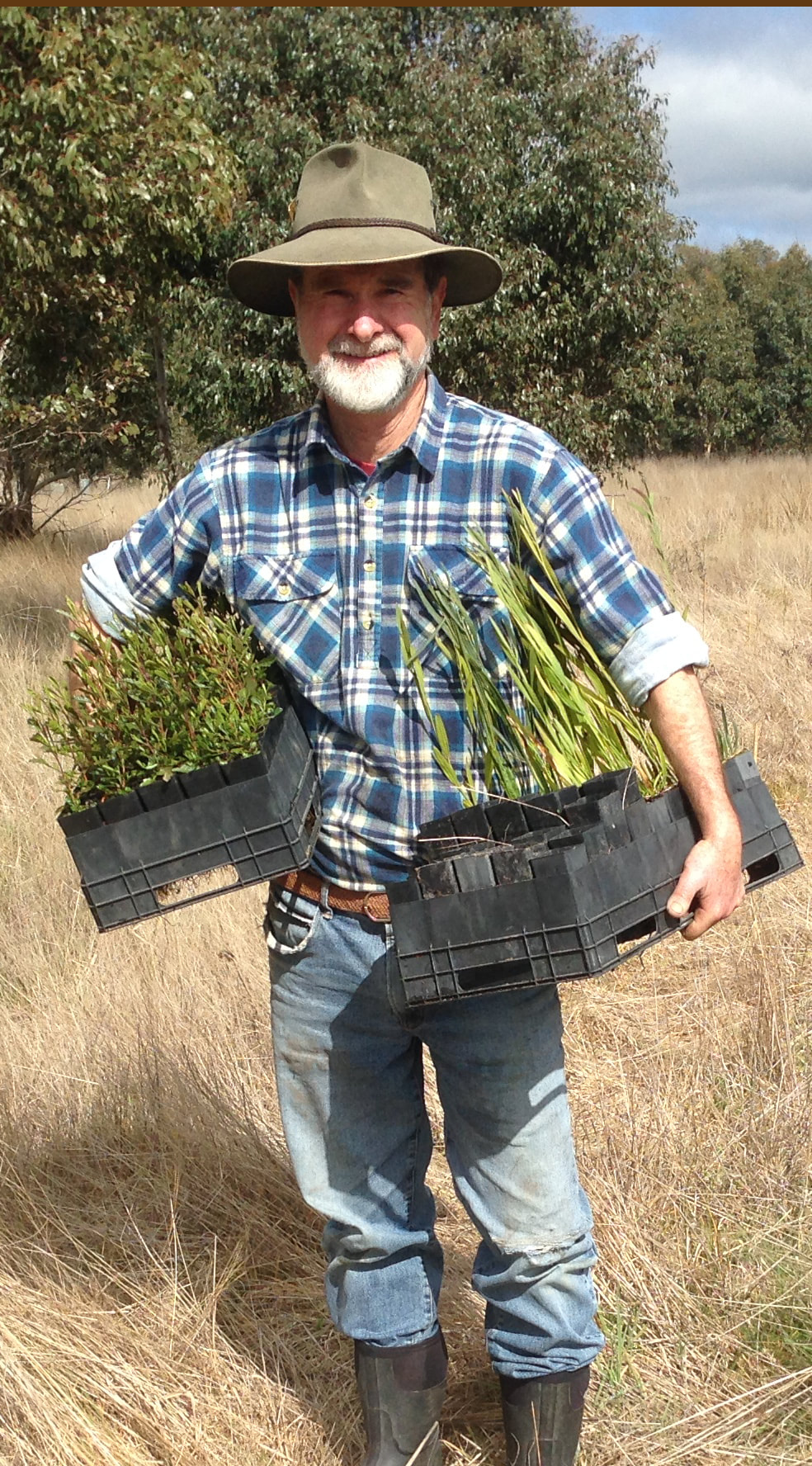
Stephen Murphy is an author, ecologist & Master Treegrower. He has worked as a nurseryman and designer of natural landscapes for over 30 years. He presently advises farmers, small landholders and governement agencies on sustainable landsacape design.
His recent book:
'RECREATING the COUNTRY' Ten key principles for designing sustainable landscapes Second edition Updated & expanded, is available to buy Click on the image below to read more 

|

 RSS Feed
