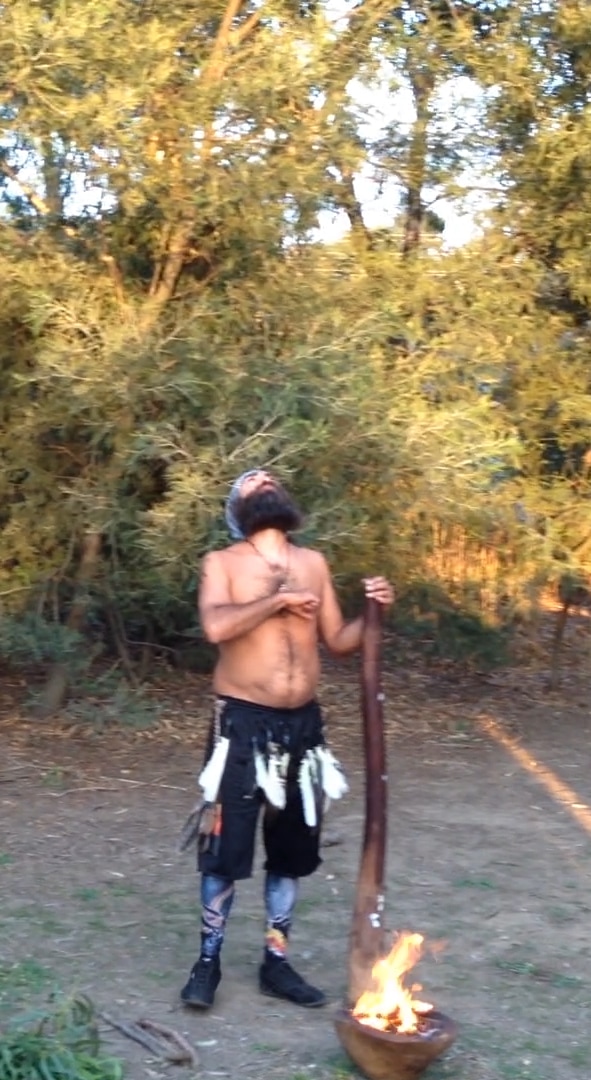
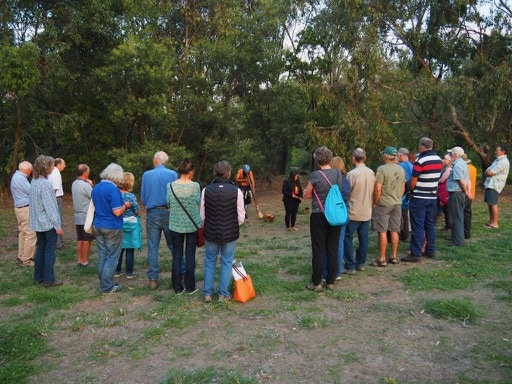
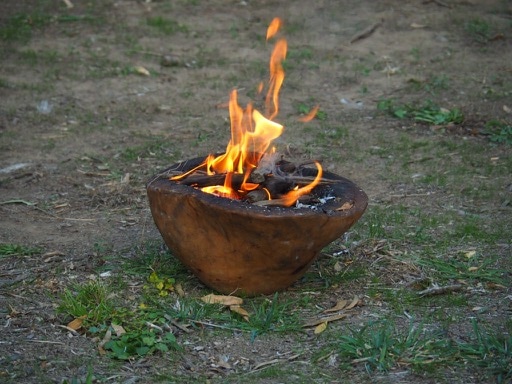
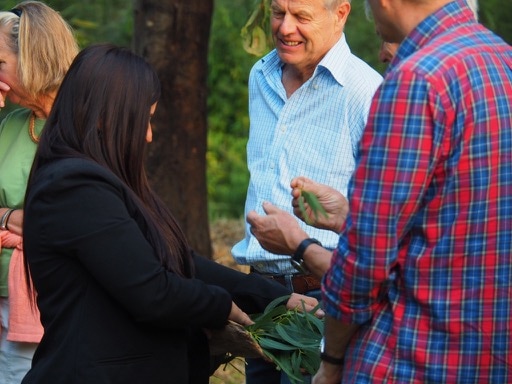
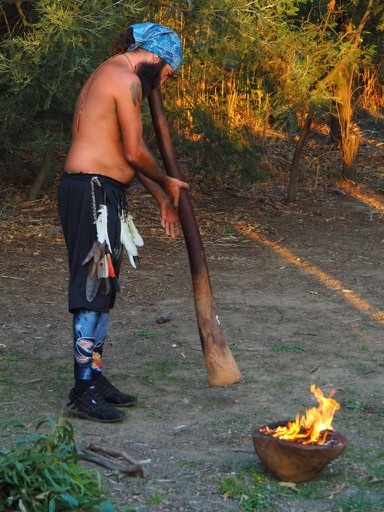
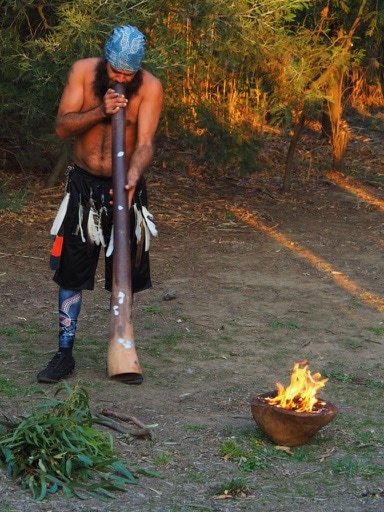
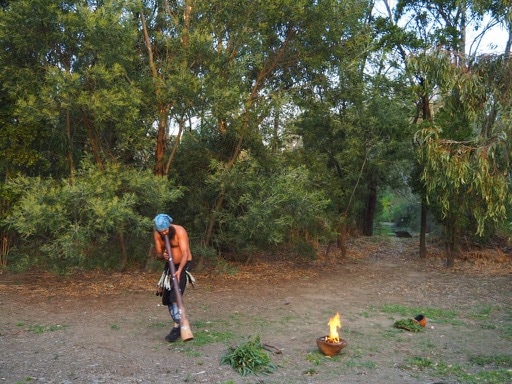
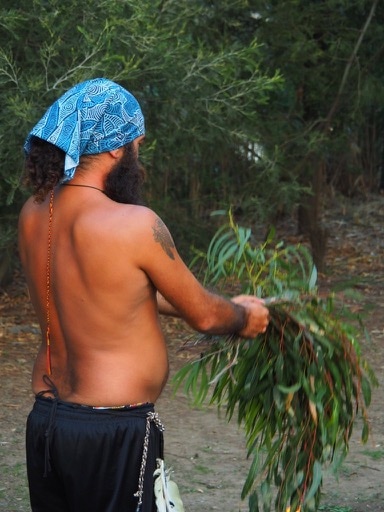
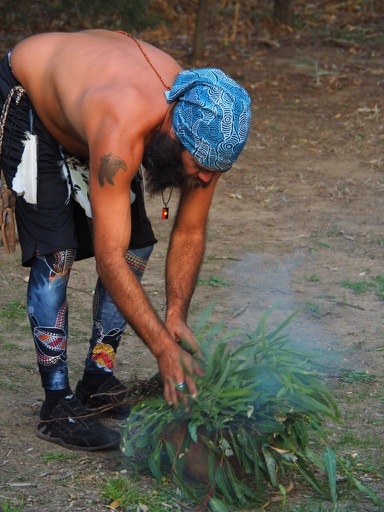
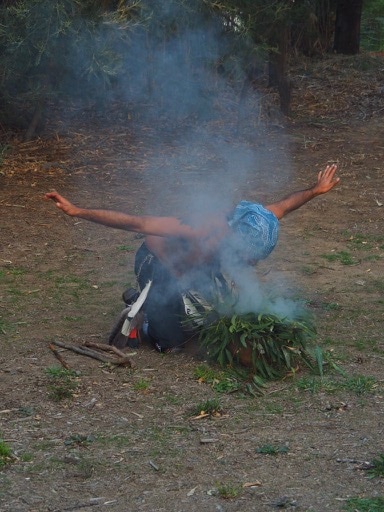
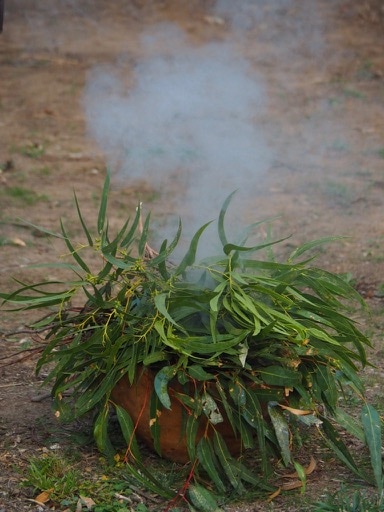
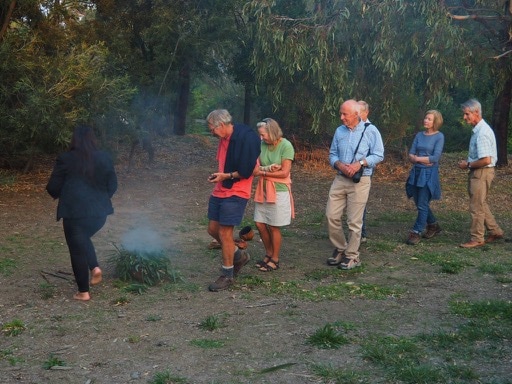
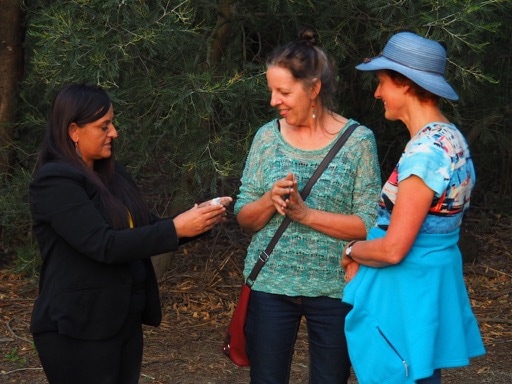
 Norm Stanley preparing for the Welcome to Country ceremony to begin the Big Barwon River Walk Norm Stanley preparing for the Welcome to Country ceremony to begin the Big Barwon River Walk We stood as a group of about thirty in a semicircle on a scantily grassed clearing that was sloping gently toward the bank of the Moorabool River. Behind us was the Barwon River with its magnificent old River Red Gums. It was once a sacred place where the two rivers met, a confluence of life giving waters that flowed clear and pure from the Otway Ranges and from the Wombat Forest. Today it was a sacred place once more. Today marked the coming together of two cultures both ancient and new, both cultures looking to forge an understanding, a connection, a respectful appreciation with each other and the mighty Barwon River. It was the beginning of the fourth and final leg of the Big Barwon River walk, an epic discovery adventure over four years organised by the Upper Barwon Landcare Network.  The high, clear, penetrating sound of the Clapsticks rang out as Corrina Eccles accompanied the didgeridoo The high, clear, penetrating sound of the Clapsticks rang out as Corrina Eccles accompanied the didgeridoo A Sulphur Crested Cockatoo screeched as it searched for a perch high in the canopy of the trees. The young dark skinned man who was the focus of our attention looked up and thoughtfully followed the bird’s flight as if he had a primal empathy with this raucous interloper. The young man was Norm Stanley from the Wathaurung Aboriginal Cooperative and he was here with Corrina Eccles to welcome us to country. There was a small fire burning at his side which appropriately had been set in a hollowed-out burl cut from the fallen limb of a River Red Gum. To make the hollow Corrina explained, was a process of repeated burning and chiselling. This primordial practice produced an aesthetically beautiful wooden bowl that had to be pre-soaked with water so that it could cradle a small fire.  The familiar rhythmical drone of the didgeridoo The familiar rhythmical drone of the didgeridoo Corrina carried layers of fresh young branches with grey/green River Red Gum leaves from which we could select a leaf for our part in the smoking ceremony to come. She embraced the small leafy branches with the solemnity of a monk carrying a holy relic among the gathered faithful. The familiar sound of the didgeridoo brought our attention back to Norm, who now bare chested with his hair held back by a pale blue headscarf, was focused on his art, his abdomen and cheeks sucking in and exhaling air to produce a continuous drone. He eased into a regular rhythm accompanied by a mellow echoing tap with his ringed finger against the wood of the didgeridoo and the high, clear penetrating sound of Corrina with the Clapsticks. The rhythm of these three synchronised sounds was spellbinding. 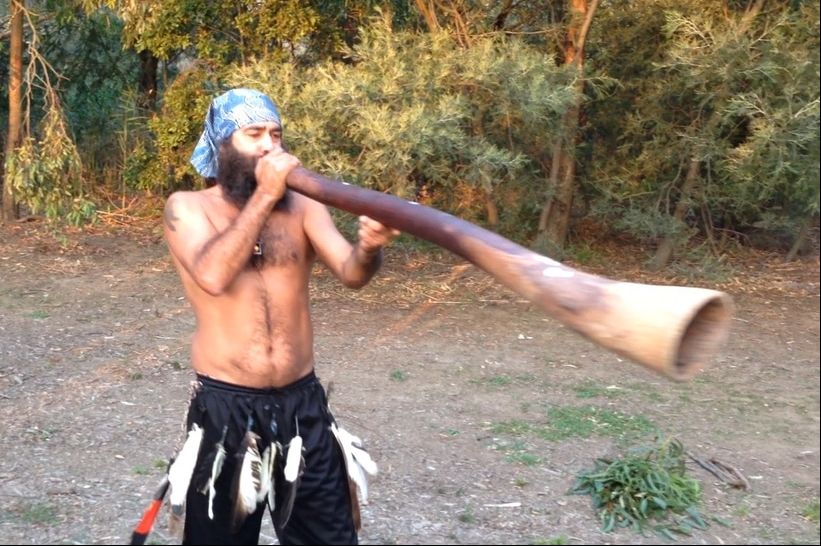 The didgeridoo was flared at the end like a baroque trumpet The didgeridoo was flared at the end like a baroque trumpet The spectacle was immersing as we were carried back hundreds of years to when indigenous travelers were welcomed and inducted onto these traditional lands of the Wada Wurrung people. The scene had a solemnity and a grandness that was uniquely Australian. Norm walked among us and played his remarkable instrument that was flared at the end like a wooden baroque trumpet. 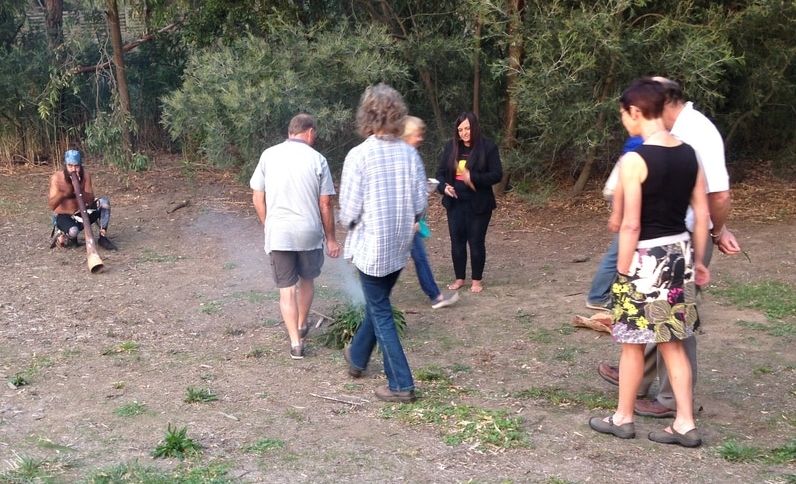 Each traveler in turn walked through the cleansing smoke Each traveler in turn walked through the cleansing smoke An aromatic smoky eucalyptus scent filled the air as Corrina added leaves to the glowing coals in the red gum burl. We were all invited in turn to bring our leaf and place it on to the growing layers that were giving off plumes of white smoke. The modern day travellers on the Big Barwon River walk entered the smoke to cleanse away any negative thoughts that they may have brought with them and to invite the ancestors to come and watch over the travelers to ensure a safe journey. I recalled an image of a Catholic priest at benediction swinging his smoking brass ‘boat’ sending sweet smelling plumes wafting down the church’s isles. By comparison this very ancient ceremony that we were witnessing had a simplicity and a raw honesty that perfectly fitted this open air ‘cathedral’ with its huge red gum pillars and its vaulted leafy ceiling towering overhead 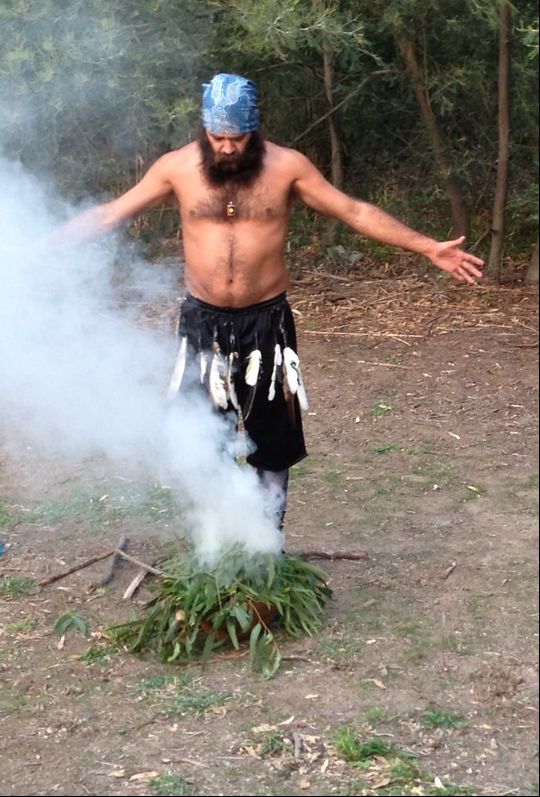 Norm Stanley raised his arms and said, "from my old people I gift you this smoking ceremony" Norm Stanley raised his arms and said, "from my old people I gift you this smoking ceremony" Norm Stanley welcomed the group in Wada Wurrung with the unfamiliar sounds of; “Nyoorra woorreeyn. Keem barne barre Wada Wurrung. Kitjarra ngitj, bitjarra ngala, mok-tjarra ngitj. Keen keen beel baa Yoowang ngitj,’’ These words carried with them the mystery and allure of an oracle’s prayer. (See the translation below). His welcome in English included ancient symbolism as he turned to each of the four corners of the compass; “North acknowledges water and white clay for purification; East acknowledges the rising sun, golden sands and the winds that shape them; South acknowledges the charcoal that remains in the earth and reminds us of our old people; West acknowledges fire and red ochre. Fire of the flames of the camp fire that burns in our hearts. Red ochre that was gifted to us for ceremony to remind us that we came from the earth and our spirits from the red sunset”. Norm turned to the group and with his arms raised said, “from my old people I gift you this smoking ceremony” 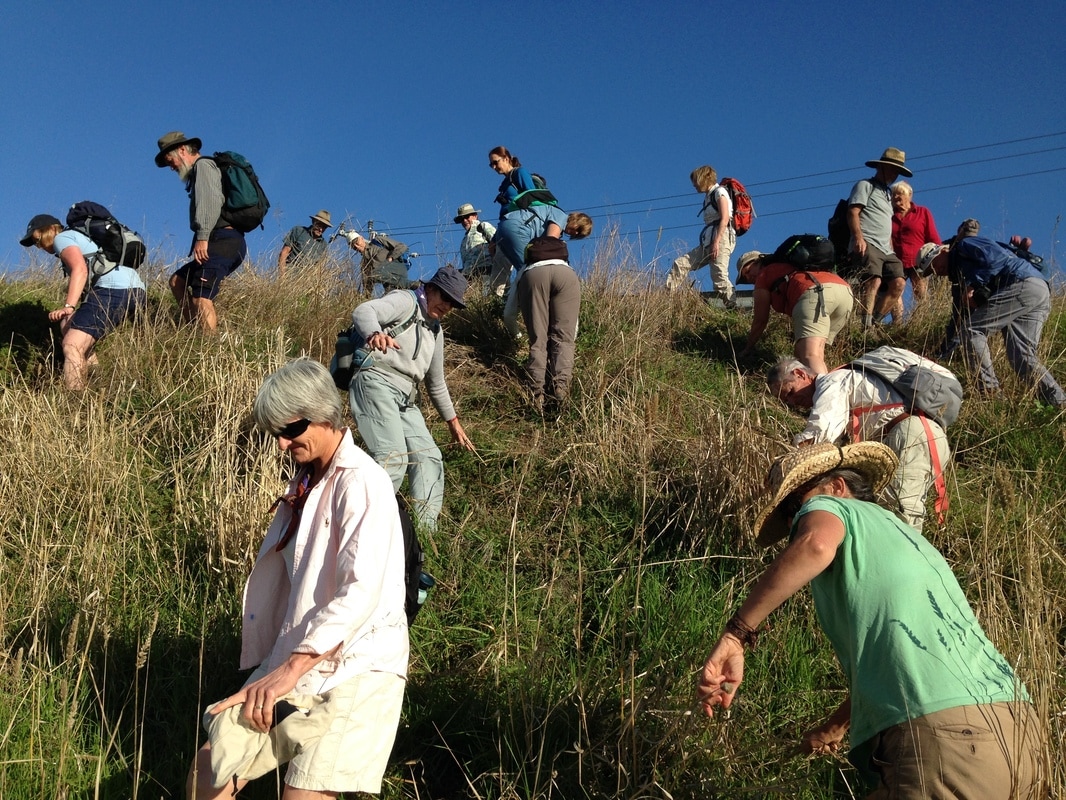 The start of day 1. Walkers scrambling down the bank beside the Merrawarp Bridge The start of day 1. Walkers scrambling down the bank beside the Merrawarp Bridge Translation of the Wada Wurrung welcome to country – “Hello, how are you. This is Wada Wurrung country. Let us talk together in friendship. Let us walk together, let us not fight, let us have peace and learn, black and white together, thank you”. Footnote: Over the next three days, 7th, 8th, 9th April, the Big Barwon River walk was successfully completed. Day 1 – 20 km walk and paddle from Merrawarp Bridge to Breakwater; Day 2 – 20 km kayak from Breakwater across lake Connewarre to Sheep Wash reserve at Barwon Heads Day 3 – Short guided walk to The Bluff at Barwon Heads to complete the four year project. Congratulations to Jennifer Morrow, Mandy Baker, all the organisers and participants for a truly remarkable and personally fulfilling experience. To view a video clip of Norm Stanley on the didgeridoo and Corrina Eccles on the clap sticks click to the Geelong Landcare Networks Facebook page here. https://www.facebook.com/GeelongLandcareNetwork/ Geoff Anson from Barwon Ridge winery doesn't just make award winning wines. Geoff's photos tell the story; Please click on the images to enlarge and to read the captions.
0 Comments
Leave a Reply. |
Click on the image below to discover 'Recreating the Country' the book.

Stephen Murphy is an author, an ecologist and a nurseryman. He has been a designer of natural landscapes for over 30 years. He loves the bush, supports Landcare and is a volunteer helping to conserve local reserves.
He continues to write about ecology, natural history and sustainable biorich landscape design. 
|
 RSS Feed
